Frequency Range: Identify the frequency range that your applications need. Additionally, consider the need to measure out-of-band emissions and harmonics. For instance, if you’re working with Wi-Fi signals, you need a spectrum analyzer that covers not only the carrier frequencies at 2.4 GHz or 5 to 7 GHz, but also adjacent channels and 2nd, 3rd, or higher harmonics.
Instantaneous Bandwidth and Measurement Speed: RF applications such as real-time spectrum monitoring require very fast acquisition and high sampling rates over large sections of the spectrum, coupled with rapid signal processing to ensure that the spectrum analyzer can capture, process, and display fast transients and unexpected RF behaviors. Greater signal processing power leads to more favorable “Probability of Intercept” times (lower POI times), a measure of how fast a signal can appear and disappear with 100% probability of the spectrum analyzer capturing it.
Resolution Bandwidth (RBW): High-sampling rates and the ability to produce a lower RBW is crucial for discriminating and analyzing densely populated signal environments, like commercial wireless bands and satellite communications where signals are closely spaced.
Dynamic Range: For applications like radar system testing where the emitted signal and its echo have vastly different amplitudes, or when monitoring the RF spectrum for the presence of unauthorized transmitters, a higher dynamic range is essential to measure both strong and weak signals simultaneously without saturating the receiver.
Sensitivity: Sensitivity is vital for detecting low-level signals. Choose an analyzer with a low noise floor for sensitive applications like electronic warfare or remote sensing.
Specialized Triggers: Capturing fast RF transients, unforeseen signals, and rare RF effects requires new triggering capabilities on the RF data, such as triggering on power density over a particular area of the spectrum, applying customizable trigger masks over power and frequency, and deciding to capture data on specific pulse durations.
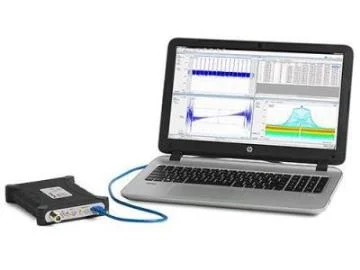
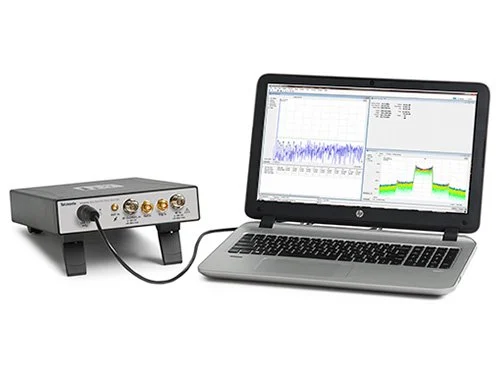
Powerful Visualization and Automation Software: Extensive analysis of today’s complex RF signals requires advanced RF software and measurement automation tools to speed up research, development, validation, and test of RF signals, devices, and systems. Furthermore, the ability to get new test and measurement capabilities through regular software updates amplifies the value of your spectrum analyzer.
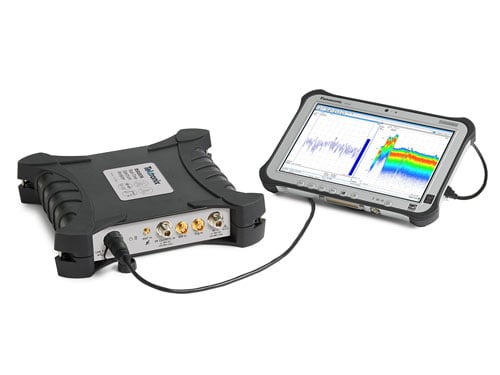
Portability and Size: Engineers working on field validation and test of telecommunications, radar, and electronic warfare require portable, lightweight, low-power, rugged analyzers that can withstand harsh field conditions and operation while producing reliable RF data.
Calibration and Service: High-quality analyzers coupled with comprehensive calibration, maintenance, and repair services lead to greater measurement reliability, reduced downtime, and a more valuable long-term investment.